I don't know that I know what it feels like to genuinely be lonely, but I could imagine it is one of the worst things a human could experience. We weren't made to be alone, and to be separated from our loved ones not knowing if we'd see them again would kill our spirits. My favorite memories are those that I have spent time with my family and friends. I hold those memories by taking pictures and hiding the treasured times in my heart.
I hope that everyone got a chance to look at the powerpoint on the second site listed. I had to do a research project on Dorothea Lange two years ago and have loved her work ever since. She captures the moment rather well, from landscape shots right down to the emotions of her subjects. Just looking through the pictures on the slideshow made my heart go out to the Japanese Americans who were relocated by force.
The picture on the tenth slide there is a little girl receiving a shot. Part of the quote on the slide reads, "As a safeguard for health, evacuees of Japanese descent were inoculated as they registered for evacuation at 2031 Bush Street..." The little girl looks like she's trying to get away because she doesn't like the shot. I think this could be symbolic of the Japanese Americans being forced against their will to leave their homes to be a prisoner of their own country.
Many of those who were relocated didn't even fight back even though they were upset and confused as to why their own country would be doing this to them. I like how on the PBS site it told about a man named Fred Korematsu who did fight back and was arrested because of it. The U.S. Government later apologized for their actions, admitting they were racist, and compensated Fred's family along with many others.
First Half:
I think Cynthia Kadohata does a wonderful job portraying the lives of Sumiko and her family at the time when Japan bombed Pearl Harbor. The whole story is sad and I developed a sympathy for Sumiko and her family. Life was hard enough for her before the bombing of Pearl Harbor. Sumiko did not have many friends and was not allowed to go to the Japanese school where she might have actually made some friends. The kids in her class picked on her simply for being different. Things had changed in Sumiko's mind the day she got that invitation to the birthday party. I kind of suspected that she would show up and not be able to participate. I couldn't believe that the mother of all people had the nerve to send her away.
Another person I was not fond of was Sumiko's teacher, Mr. Johnson. The way it was described, he acted so disappointed in his students if they answered one of his questions incorrectly. Also, I do not see any need to play the game of P-I-G in the classroom, especially when the student's names are written up on the board with the letters beside them when they answer wrong. I would not have the heart to make my students feel poorly about their answer when it is incorrect when they have honestly made an effort to answer. It is better to recognize their effort and, if need be, redirect their thinking so that they are able to answer correctly, or have someone else in the class help them. If I had been in a class like Mr. Johnsons I would have never wanted to answer a single question for fear of disappointing him and being called out on how I was wrong.
I have never had a loved one taken away from me in the sense that they are still alive, but living somewhere where I would not be able to visit with them again. I can't imagine how hurtful that would be, but it is just what Sumiko and her family experienced. Her family, like many others, had done nothing to be disloyal to the United States but Jiichan and Uncle were still taken away. Later on they recieved a letter from her Uncle who had been taken to a prison camp in North Dakota. I thought it was so cruel that there were parts of his letter blacked out in our government's attempt to censor outgoing mail from the camps. First we imprisoned innocent United States citizens and then go through their letters to loved ones back home to make sure they don't say anything bad about the government. That was their only means of communication with each other, and our government was so paranoid that they couldn't even let them have that as their own.
Second Half:
One of the things I enjoyed most in the second half of this book was the relationship between Sumiko and Frank. I think he helps her to grow stronger and believe in herself more. In chapter 28, Sumiko and Frank are talking about farming and what they both would like to do someday. Sumiko talks about how, before the war, she wanted to own a flower shop but says that now she may just end up working in a factory. I love how Frank just lays it out there. He tells her "You don't need white people to tell you it's okay to own a flower shop". I think that helps Sumiko to get the courage she needs to someday do that when the war is over. It can also show students that true friends are there for you through life, not only to have fun and play but also to be an encouragement and to show you that you really can achieve the things you desire most.
Lying was a thing I noticed that came up somewhat throughout the story. On page 175 it says, "lying certainly offered satisfactions, but the problem was it left a bad aftertaste" which was after Sumiko had lied about something like Sachi always did. At the end of the book, Sumiko realizes that Sachi lied because of her sadness, fear, and loneliness. Sachi's feelings probably developed after being taken from her home at the start of the war. Sumiko also says that she will still write Sachi because she is her friend, even though she lies. I believe that Sumiko had empathy for her friend she met in Poston, because she had endured the same type of hardship. This can teach students that people act the way they do because of their past experiences, not necessarily because they like to bully others. It can also teach them to be empathetic toward their peers and still try to be a friend to those who may be having a hard time.
It really touched me in the last chapter when it was talking about freedom. It says, "And she realized that it had not been freedom that Jiichan came to America for, but the future. And not his future, but hers--the future of his unborn grandchild. That's why he had left Japan. He had loved her even before she was born." It shows what devotion Jiichan has to his family, and how he wanted to make sure she had a good life in America. How ironic that they were now in an internment camp with miles separating the two of them. This also makes me think of Christ and His love for us. Not that it would be appropriate for classroom discussion, but it talks in the Bible about how God created our inmost being and knit us together in our mother's wombs. (Psalm 139:13) He knew us before we were born and loved us before our parents even knew about us. It creates a sense of family and belonging. I'm sure this was true for Sumiko also since her parents had passed away. It allowed her to feel more accepted by her family and to know that she really was loved.
Below is a map I found of the relocation center in Poston, AZ Sumiko and her family were sent:
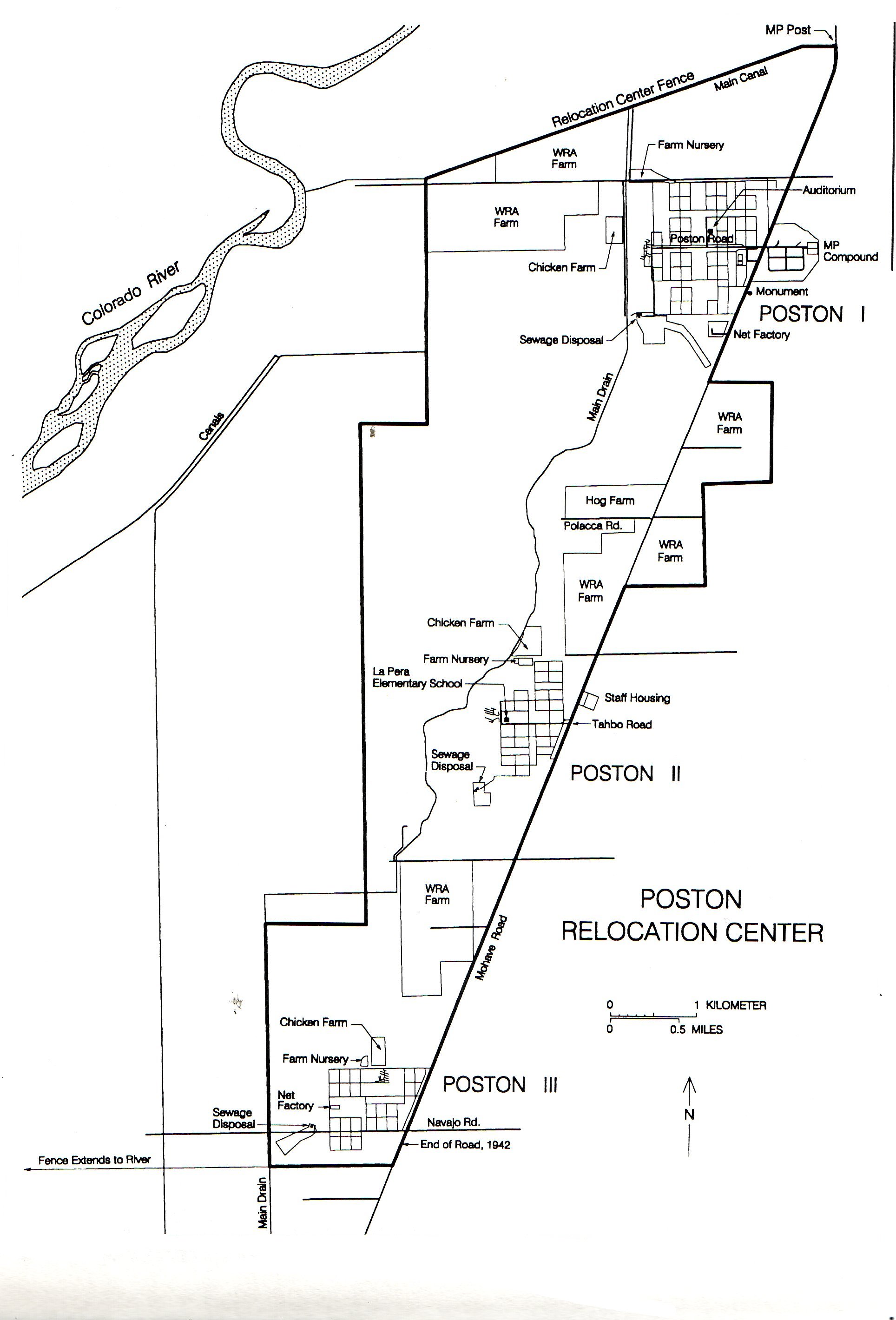
(click on the picture for a larger view)


2 comments:
I was really surprised at how few Japanese-Americans retaliated against the government during this time. One would think that everyone would try to do all they could to keep their land, their homes, and to keep their families together, but I guess the example of people like Mr. Korematsu being arrested frightened them enough to make them stifle their opinions.
I felt the same way about the P-I-G game. That is a horrible way to try and make students learn. Thank you, also, for pointing out the Dorothea Lange photos.
Post a Comment